


Properties ofPROMPT NATURAL CEMENT
Quick setting & hardening

The mineralogical composition of PROMPT natural cement gives it specific properties of rapid initial setting followed by immediate hardening. This specific mineralogical composition comes from a complex family of aluminate and sulfo-aluminate minerals formed at moderate firing temperatures. Its unique qualities of rapid setting and hardening make it an ideal material for applications such as sealing, repairs, waterproofing, plugging waterways, and many more.
The exceptional speed of setting and hardening of PROMPT natural cement, between 15 and 90 minutes depending on the mortar dosage and chosen setting time, allows for quick protection of structures against weather conditions, cold, or rapid reactivation. It should be noted that the setting time is adjustable. According to the NF P 15-314 standard, it must be less than 4 minutes. The setting time of PROMPT natural cement mortar is reduced to 2 minutes at 20°C and 1 minute at 30°C. Conversely, this setting can be delayed up to 30 minutes using the TEMPO retarder.
Furthermore, Vicat PROMPT natural cement is characterized by a very quick increase in its early-age mechanical strengths, making it a true "force of nature." As evidence, its minimum compressive strength values are 4 MPa from 15 minutes at 20°C. These values often allow for formwork removal and/or reactivation. It's important to notice that the strength of PROMPT natural cement continues to increase steadily over time, even for many years.
The high initial strength properties and almost instantaneous hardening of PROMPT natural cement make it suitable for various types of supports and numerous applications such as restoration, decoration, water and sanitation, and rapid masonry. Indeed, one of its traditional uses is sealing.
The speed of PROMPT natural cement allows it to replace a multitude of small jobs that would typically be done with ordinary cement, such as partition assembly, stair steps, installation of channels, and concrete work. In short, it adapts to any construction field and brings speed, high initial strength, hardening, and durability.
Résistance à la compression du Ciment Naturel Prompt
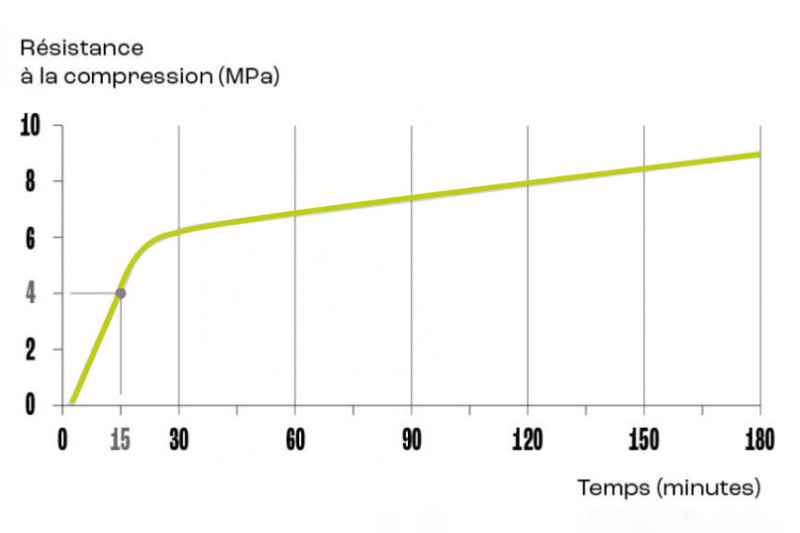
Progression des résistances à court terme, en minutes
Mortier de Prompt au dosage 1-1 en poids (2 volumes de Prompt pour 1 volume de sable).
E/C = 0.4
Remarque : pour le mortier de Prompt au dosage courant 1-1 en volume, les résistances ci-contre sont abaissées de 30% : les 4MPa sont obtenus à 30 minutes.
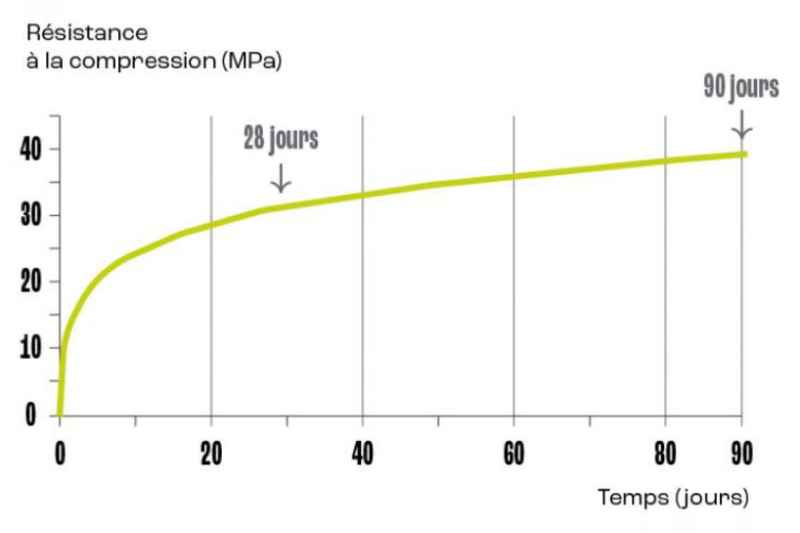
Progression des résistances à moyen terme, en jours
Mortier de Prompt au dosage 1-1 en poids (2 volumes de Prompt pour 1 volume de sable)
E/C = 0.4
Remarque : pour le mortier de Prompt au dosage courant 1-1 en volume (1 volume de Prompt pour 1 volume de sable), les résistances ci-contre sont abaissées de 5MPa.
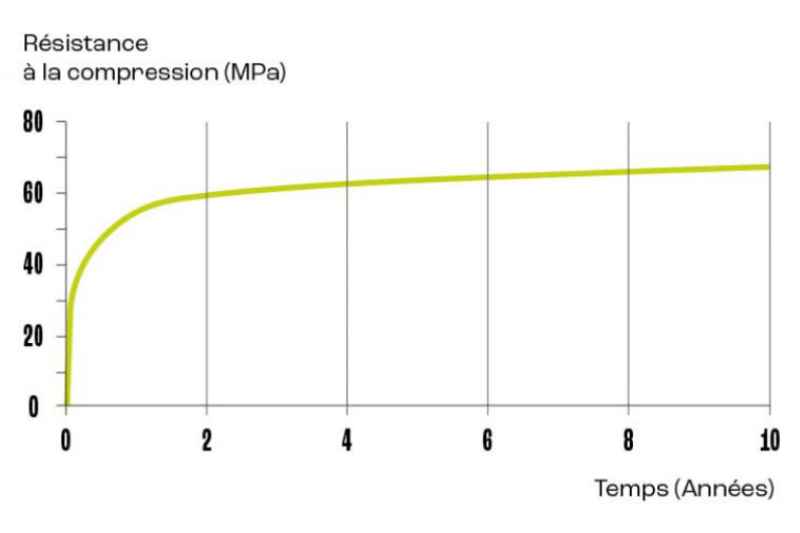
Progression des résistances à long terme, en années
Mortier de Prompt au dosage 1-1 en poids (2 volumes de Prompt pour 1 volume de sable)
E/C = 0.4
Les facteurs qui influencent le temps de prise
Plusieurs facteurs influencent le temps de prise du Ciment Naturel Prompt et doivent être connu afin d’anticiper les différentes réactions du mortier :
- La température : La température au moment de la mise en œuvre affecte significativement le temps de prise. Par exemple, à 10°C, le temps de début de prise est de 4 minutes, alors qu'à 30°C, il n’est que d’une minute.
- Les adjuvants : L'utilisation du retardateur TEMPO peut prolonger le temps de prise jusqu'à 30 minutes, permettant une mise en œuvre plus longue en fonction des besoins du chantier.
- Le dosage du mortier : La proportion de ciment, de sable et d'eau dans le mélange influence la vitesse de prise. Il est conseillé de respecter le bon dosage pour chacune des différentes applications, afin d'obtenir un mélange optimal.
La maîtrise de ces différents paramètres permet d'ajuster le temps de séchage du ciment naturel en fonction des besoins de votre ouvrage, assurant ainsi une mise en œuvre parfaite sur tous les chantiers.
Les conséquences d'un temps de prise non approprié
Un temps de prise non approprié du Ciment Naturel Prompt peut entraîner des problèmes de sécurité et de durabilité des ouvrages. Si le temps de prise est trop rapide, cela peut compromettre la qualité du scellement et la résistance mécanique initiale. À l'inverse, un temps de prise trop long peut retarder la mise en service des ouvrages et les exposer aux intempéries et au froid, fragilisant ainsi l’ensemble.
Les propriétés de résistances initiales élevées et de durcissement presque instantané font du Ciment Naturel Prompt un matériau pouvant s’adapter à de nombreux domaines : restauration du patrimoine et du bâti ancien, décoration, domaine de l’eau et de l’assainissement, éco-construction…
Véritable accélérateur de travaux, le Ciment Naturel Prompt se substitue également aux ciments courants dans un grand nombre de travaux dans le domaine de la maçonnerie tels que le montage de cloisons, la création de marches d’escalier, la pose de caniveaux, le bétonnage et le scellement.
Application temperature limits for Natural Prompt cement
Natural Prompt cement is applied between +5 °C and +30 °C in accordance with Vicat recommendations. Within this range, the ambient temperature directly influences the start of setting time and requires the implementation to be adjusted.
Ambient temperature | Behaviour | Adjustment |
Below +5 °C | Outside the application range recommended by Vicat | Do not apply; postpone the project |
+5 °C to 10 °C | Slowed setting, longer start of setting time (4 minutes at 10 °C) | Reduce or remove the TEMPO dose |
10 °C to 20 °C | Reference conditions (2 minutes at 20 °C) | Standard TEMPO dosage according to the desired open time |
20 °C to 30 °C | Accelerated setting, reduced start of setting time (1 minute at 30 °C) | Adjust the TEMPO dose and use cold mixing water |
Above 30 °C | Outside the application range recommended by Vicat | Postpone the intervention or work in the early morning |
Implementation in cold weather
Between +5 °C and 10 °C, the setting is naturally slowed down: the start of setting time reaches 4 minutes at 10 °C, compared to 2 minutes at 20 °C. In these conditions, reduce the TEMPO dose or remove it so as not to lengthen the open time excessively. The substrate must be clean and free from frost. Once the structure is completed, protect it from draughts and cold during the hardening phase.
Below +5 °C, do not apply natural Prompt cement and postpone the project.
Implementation in hot weather
Above 20 °C, setting accelerates: 1 minute of start of setting time at 30 °C. To preserve a sufficient open time, adjust the TEMPO dose according to the indications of the online calculator and use cold mixing water. Work in small batches adapted to the surface to be treated.
Above 30 °C, do not apply natural Prompt cement and prefer the coolest hours of the day.
Storage of the bag before use
Natural Prompt cement must be stored in a dry place, sheltered from humidity and frost. A bag that has suffered moisture infiltration or freeze/thaw cycles will show partial premature setting and a loss of reactivity, and must be discarded for demanding projects.
Frequently asked questions
Natural Prompt cement is used as mortar (with sand and water), as concrete (with sand, gravel and water) or as pure paste (with water only, for emergency sealing and submerged works). Application is recommended between +5 °C and +30 °C. The substrate must be clean, free from any loose parts, and dampened without excess before application. Prepare small batches adapted to the surface to be treated: the rapid setting does not allow time to work a large volume in a single operation. The TEMPO retarder allows the open time to be lengthened according to the project needs.
Natural Prompt cement is used as mortar (with sand and water), as concrete (with sand, gravel and water) or as pure paste (with water only, for emergency sealing and submerged works). Application is recommended between +5 °C and +30 °C. The substrate must be clean, free from any loose parts, and dampened without excess before application. Prepare small batches adapted to the surface to be treated: the rapid setting does not allow time to work a large volume in a single operation. The TEMPO retarder allows the open time to be lengthened according to the project needs.
Natural Prompt cement does not dry: it sets by chemical reaction with water. The start of setting on pure paste occurs in less than 4 minutes at 20 °C. Hardening, which corresponds to the rise in mechanical strength, takes place in the minutes that follow. Once setting is complete, the mortar at the reference dosage exhibits a compressive strength of more than 4 MPa at 15 minutes, which allows a very rapid return to service of the structure.
Natural Prompt cement develops its strengths from the very first minutes after setting. At the reference dosage (mortar 1/1 by weight), the compressive strength exceeds 4 MPa at 15 minutes. The values continue to increase in the hours, days and weeks that follow, and continue to progress over several years. For the precise values at 1 day, 7 days and 28 days, refer to the technical datasheet available from the Vicat technical department.
Unmoulding is possible as soon as the mortar or concrete has completed its initial hardening phase, generally between 15 and 90 minutes depending on the dosage and temperature. For a step or a repaired floor, return to pedestrian circulation is possible after a few hours. For uses subjected to heavy loads (vehicle traffic, heavy loads), wait at least 24 to 48 hours. At low temperature (close to +5 °C, lower limit of recommended application), these times must be lengthened.
Achievements

