


Restoration & decoration
Stone imitation
Works
Imitating stone with natural cement
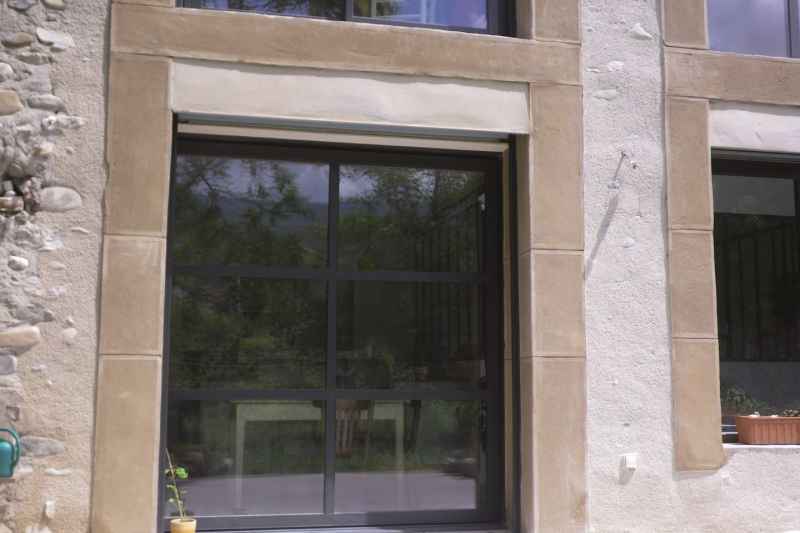
Restoring cornices, window frames, and facade corner elements while giving the illusion of stone decoration brings authenticity and character, all within a reasonable budget. Similarly, it's possible to enhance the aesthetic quality of garden features such as basins, fountains, bridges, arches, and garden walls by employing stone imitation techniques that create impressive trompe-l'œil (illusion) effects.
For further information:
PROMPT natural cement by Vicat, applied as plaster or finishing layers on soft, medium, or hard substrates, can replicate the appearance of natural stone. This process offers a wide range of possible outcomes. The use of PROMPT natural cement provides numerous choices in terms of :
- Shapes: Stone imitations can be adapted to harmonize with the nearby buildings and landscapes.
- Colors: The natural color of the PROMPT natural cement plaster is naturally ochre. It's possible to modify this color by adjusting the sand color or by adding natural colorants such as yellow ochre, reddish-brown earth, raw sienna, etc. The addition of lime to the PROMPT natural cement plaster can also lighten the mixture.
- Textures: The texture depends on the chosen surface treatment that best imitates the original stone appearance. Surfaces can be smoothed, scratched, textured with a sponge, swept, brushed, cut, etched, or bush-hammered.
The technique of stone imitation using PROMPT natural cement is rapid and cost-effective compared to using real stone. PROMPT natural cement by Vicat is a durable solution that allows for quick application. Other advantages include the ability to create imitation stones and the breathability of the wall due to the permeability of the plaster.
Technique
Before you start imitating stone with PROMPT natural cement plaster, it's essential to prepare the substrate. Depending on its nature, specific care should be taken.
- For cornerstones, quoins, and rectilinear stones: outline the layout and place guidelines
- For aged stone appearances: pre-sketch the desired contours on the substrate and set markers
- For older substrates: identify hollow areas, clear them, clean, and potentially apply a scratch coat of PROMPT natural cement before plaster application
- For smooth substrates: roughen or apply a bonding primer. The substrate should be damp
Once the substrate is ready and the mortar prepared with an appropriate mix (PROMPT natural cement, sand, TEMPO retarder, water), proceed with application.
It's advisable to work stone by stone. Apply the PROMPT natural cement mortar with a trowel or float to a thickness of 1.5 cm on a new substrate.
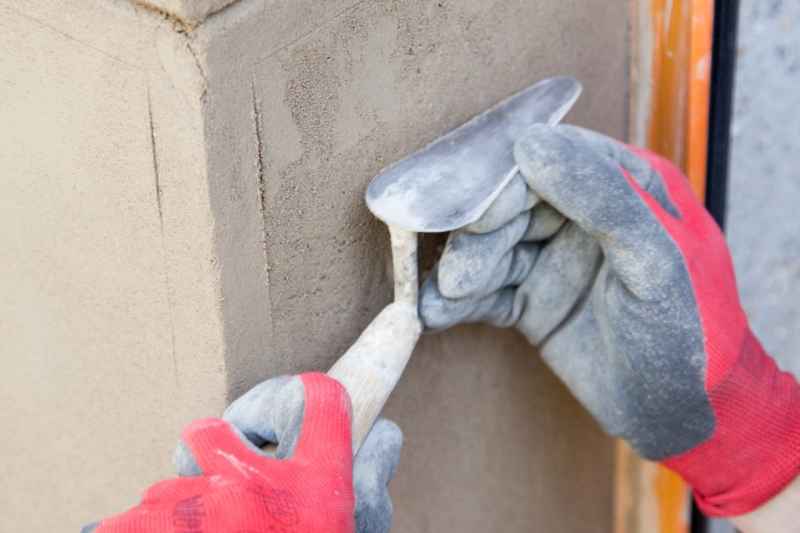
In the PROMPT natural cement mortar, mark the joints using a tool (such as the pointed end of the trowel) and then firmly compress the plaster. Check the overall aesthetic and either finish the joints or cut and potentially hollow them.
Finally, treat the surface as desired. For a natural stone appearance, uniformly scratch the entire surface. For a dressed stone appearance, leave a 1-2 cm margin around the edges that will be smoothed.
Fields of application
The imitation of natural stones using PROMPT natural cement plaster on both old and new substrates is applicable for :
- Window frames
- Corner elements
- Cornices
- Basins and pools
- Bridges
- Arches
- Garden walls
Advantages of its application
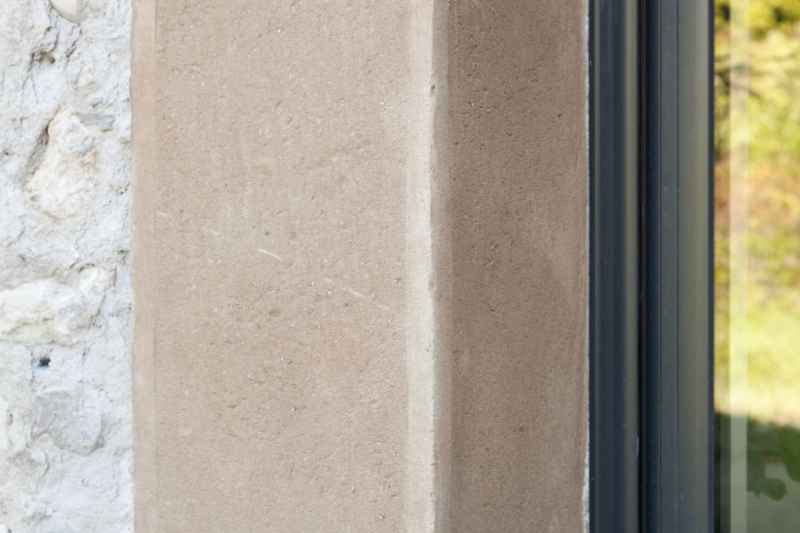
PROMPT natural cement by Vicat plasters for the imitation of natural stones offer numerous advantages:
- Natural color that harmonizes with both old and new surroundings
- Permeability of the plaster
- Quick application
- Cost-effective and durable solution
Advices
In cold weather, the minimum working temperature for PROMPT natural cement is 2°C on a non-frozen substrate and with no risk of freezing during the day. In hot weather, avoid mixing at temperatures exceeding 30°C. Work with cold water and use sand that has been stored away from direct sunlight.
Jobsite Questions
For new substrates, a thickness of 1 to 2 cm is generally sufficient. For older or uneven substrates, a spatterdash coat is recommended prior to applying the finishing render. The ability to apply in heavy thicknesses is one of the key advantages of PROMPT natural cement over conventional finishing renders.
The standard mix ratio is 1 part PROMPT natural cement to 2–3 parts sand, with the addition of TEMPO retarder depending on the ambient temperature and batch size. The water content should be adjusted to achieve a workable, plastic consistency. The online calculator provides precise mix proportions tailored to your specific project.
The surface must be worked (scraping, scoring, texture modelling) immediately after application, within the first few minutes. To extend this open time, the TEMPO retarder is strongly recommended for large surfaces or in warm conditions, providing from several tens of minutes up to over one hour depending on the dosage.
PROMPT natural cement adheres to most masonry substrates, but surface preparation is critical: smooth surfaces must be roughened or sandblasted, any loose or delaminated render must be removed, and the substrate must be dampened prior to application. An adhesion test on an inconspicuous area is recommended for atypical substrates.
The naturally ochre hue of PROMPT natural cement is compatible with most regional stones. To adjust the colour, you can vary the sand shade, add natural mineral pigments to the mix, or incorporate air lime to lighten the tone. A test sample on an inconspicuous area allows validation of the shade before applying to the full surface.
Yes. PROMPT natural cement is suitable for interior applications, particularly in areas where vapour permeability is important (heritage walls, cellars, damp rooms). Its natural mineral composition allows it to breathe with the substrate, making it a particularly appropriate choice for the renovation of historic buildings.
PROMPT natural cement has a proven track record spanning over 150 years on French architectural heritage. Once cured, the render withstands freeze/thaw cycles, moisture and thermal variations. Its natural vapour permeability prevents delamination caused by condensation. On properly prepared historic walls, durability is comparable to — or even exceeds — that of the original stonework.
No, it is not mandatory, but it is strongly recommended. The naturally rapid setting of PROMPT natural cement without TEMPO leaves very little time for finishing operations (scraping, joint marking, scoring). TEMPO extends the open time from a few minutes to over one hour depending on the dosage and temperature, facilitating careful workmanship over larger areas.
Yes, to a large extent. The texture (grained, smooth, granular), joint pattern and shade can be adjusted to closely replicate the appearance of limestone, sandstone, granite, tufa or brick. Variations in finish are achieved through the choice of sand, surface treatment (sponging, scratching, float finishing) and joint layout.
A film of natural Prompt cement on bricks must be treated quickly, before complete hardening. In the fresh state, immediate wiping with a damp sponge is sufficient. On a hardened film, brushing with a stiff brush and water removes the surface deposits. For persistent films, a diluted hydrochloric acid solution can be used by a trained professional, by rinsing abundantly after treatment and by systematically testing on a discreet area before any intervention on the visible surface.
Yes, new concrete is a substrate compatible with natural Prompt cement, provided that an appropriate preparation is followed. Smooth concrete must be pricked or sandblasted to create sufficient roughness. Wait until the supporting concrete is sufficiently hardened, i.e. at least 28 days for a standard Portland concrete. Dampen the substrate before application and, on very dense surfaces, apply a preliminary natural Prompt cement bonding coat to ensure the adhesion of the finishing render.
Achievements
Discover our realized projects


Product

Discover everything about PROMPT natural cement
The only cement with strengths at the end of setting, it allows for the quickest return to service. In formulations, it also acts as a powerful accelerator for all hydraulic binders (lime, Portland cement, calcium sulfoaluminate cement, calcium aluminate cement).